
Lofty, light, well-balanced, perfectly textured, and utterly delicious scones. This recipe produces such fantastic results that I rarely stray from the basic formula—with one exception and that involves the egg.
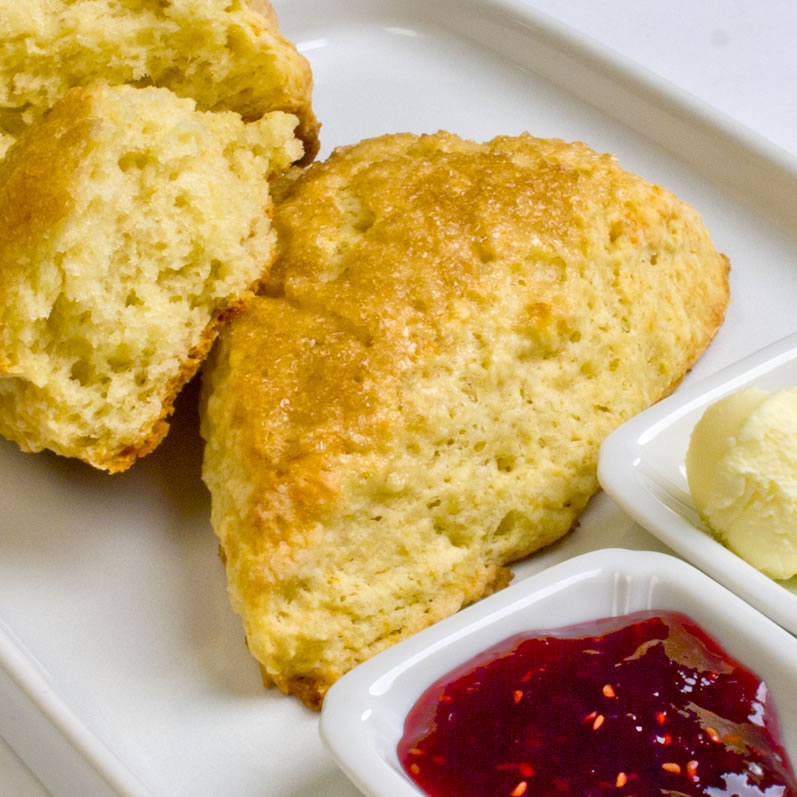
I planned to do a short post on how to make the best scones in the universe and then several days into research and testing realized that like most great things, superlative scones are not so simple after all.
This is not to say that they are difficult to make; just that there is a world of contradictory information available on the best way to produce them, plus dozens of basic formulas that run the gamut from doughs with no butter or eggs at all to doughs with large quantities of both. What is the bewildered cook to do?
Related: Grandma Mary’s Heavenly Light Buttermilk Skillet Biscuits
Well, this bewildered cook pulled several dozen reputable baking books off the shelves and compared formulas and processes. I recalibrated over a dozen formulas based on a constant of two cups of flour. When the comparisons were complete, the testing began.
I tested the low end of the spectrum, then the high end, then went straight for the middle, which interestingly was not in any of the books. The middle formula proved to be my idea of the best scone ever: Golden color, crisp on the outside, and moist, tender, and flakey on the inside. Not a cake, not a muffin, and richer than most biscuits, a scone is an entity in its own right, and it has a long tradition.
Before I go further though, here are some of the must-have cookbooks that added immeasurably to my understanding of this quintessential quick bread. Highly recommend!
- Baking for all Occasions by Flo Braker
- Flour by Joanne Chang
- Grand Central Bakery by Piper Davis & Ellen Jackson
- Nancy Silverton’s Pastries from the La Brea Bakery by Nancy Silverton
- Once Upon a Tart by Frank Mentesana & Jerome Audureau
- The Craft of Baking by Karen Demasco
A scone (pronounced either skohn or skon, to rhyme with either cone or gone) was originally a Scottish quick bread that got its name from the Stone (or Scone) of Destiny, the place where Scottish kings were once crowned. It was made with oats, shaped into triangles, and fried on a griddle. Today, scones are usually made with flour and baked. And they now come in a wide variety of shapes.
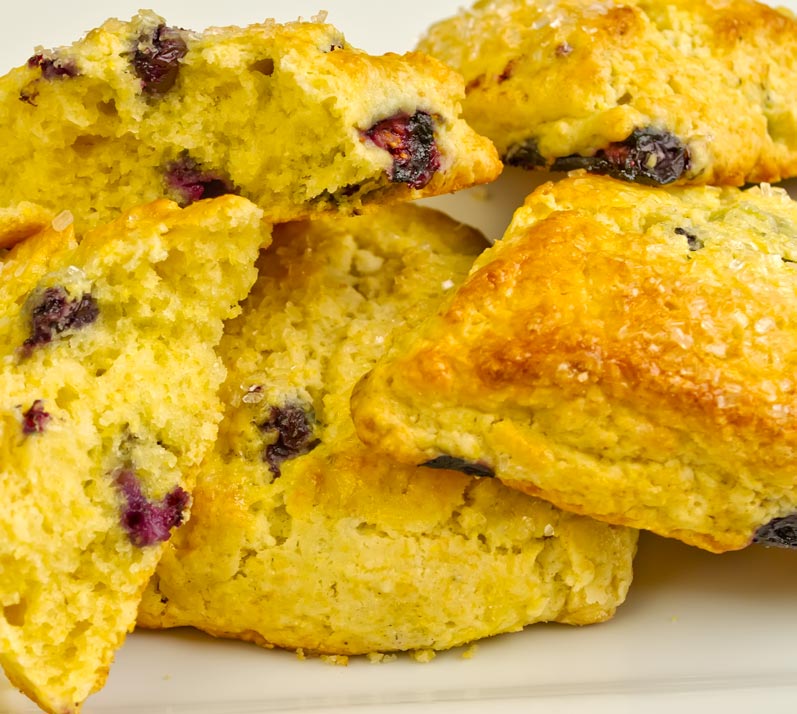
While the word ‘scone’ goes back to the 15th century, the baking powder or baking soda leavened version that we know today, as with the American baking powder biscuit, dates only to the mid-19th century.
Related: My Red Lobster Cheddar Bay Biscuits
As my testing confirmed, although the formula is important, the MOST important aspect of making the best scone possible is the technique. No formula can make up for poor technique. And by poor technique, I mean use of less than VERY COLD butter and liquid, warming of these very cold ingredients in the creation or shaping of the dough, or over handling the dough while creating or shaping it. In addition, the way in which the butter is incorporated into the flour is CRITICAL to the flakiness and tenderness of the scone.
None of this is difficult, and you will soon be making the best scones you have ever tasted. Everything you need to know is covered in the next section. Be sure to read carefully before jumping ahead to the basic recipe.
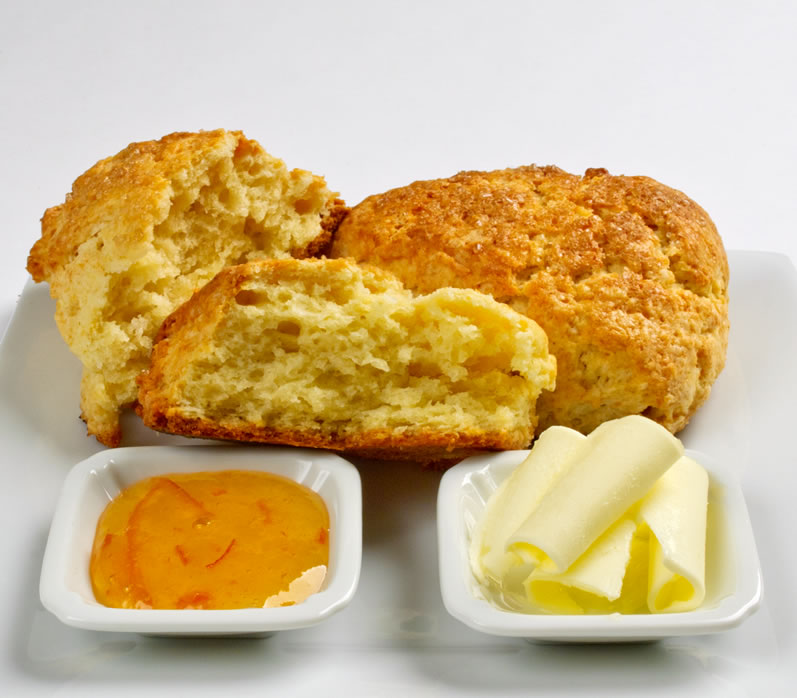
Tips & Tricks for the Best Scones Ever
Layering the Butter | Mixing the Dough
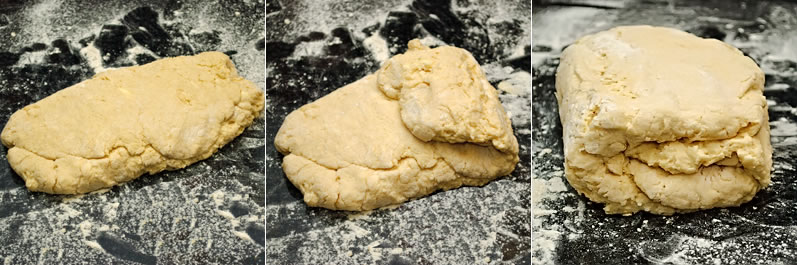
- Just as with pastry, everything depends on HOW you mix the dough. For the flakiest scones, chunks of chilled butter are rolled with flour to create large, thin sheets. Butter should not be reduced to the texture of cornmeal or breadcrumbs as specified in many recipes. In addition, gently incorporating 1-2 letter folds (as for flakey pastry or croissant dough) into the process helps to build flakey layers in the baked scone.
- There are two methods for ensuring the butter is layered, rather than incorporated into the dough.
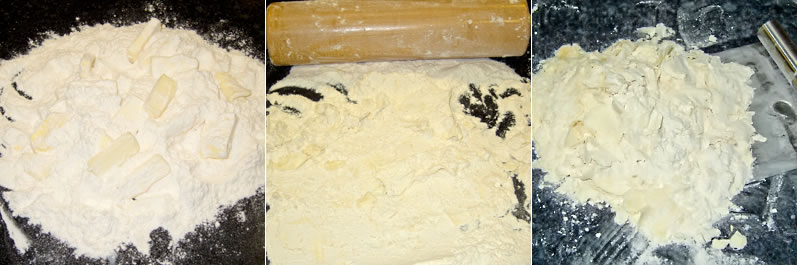
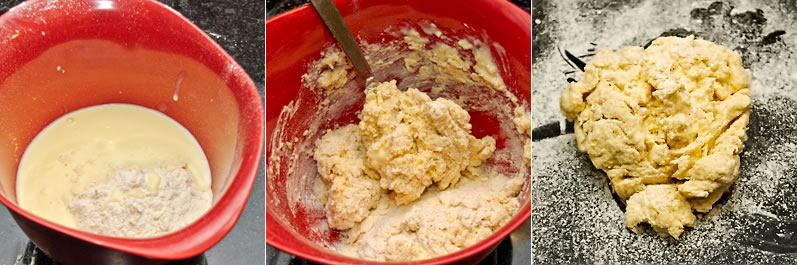
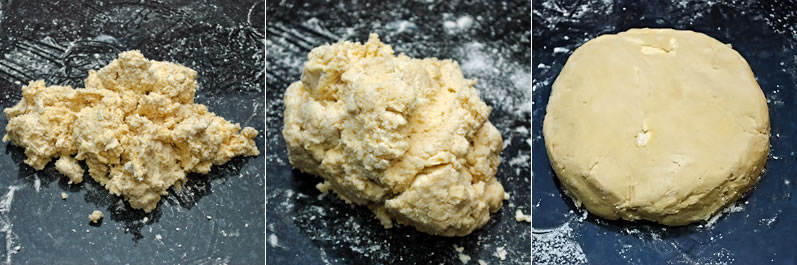
- Method 1: Cut the butter into 1½ teaspoon size chunks (16 chunks per 1 stick butter). Dump the mixed dry ingredients out onto a clean surface and scatter the very cold butter on top. With your hands, lightly coat the butter chunks with flour by tossing the two together a few times. Then, using a heavy rolling pin, roll over the mass, flattening the butter into thin sheets. Gather the mixture up into a loose mass and repeat twice more. Scoop the mixture into a mixing bowl and continue with the recipe. After the dough is formed, flatten somewhat and gently make 2 letter folds (as for flakey pastry or croissant dough) in opposite directions. This will help to build flakey layers in the baked scone.
- Method 2: Cut the butter into 1½ teaspoon size chunks (16 chunks per 1 stick butter). Add the dry ingredients to the workbowl of a stand mixer fitted with the paddle attachment. Scatter the very cold butter on top of the dry ingredients. Pulse the mixer to cut the butter into the flour, making sure not to cut the butter pieces too fine. Peas-size pieces are just about right. Add the wet ingredients and pulse the mixer a couple of times only to barely incorporate the liquid. Turn the dough out onto a clean countertop and finish by hand. After the dough is formed, flatten somewhat and gently make 2 letter folds (as for flakey pastry or croissant dough) in opposite directions. This will help to build flakey layers in the baked scone.
- Just as the lightest bread is produced from the wettest dough, scone dough should be quite soft and almost paste-like. Don’t be tempted to work more than 1-2 tablespoons of additional flour into the dough—just enough to facilitate handling.
- Don’t overmix the dough. In fact, handle it as lightly and minimally as possible. Never knead scone dough. You don’t want to activate the gluten in the flour any more than necessary.
Main Ingredients
- Best results are obtained with premium-quality flour. I use King Arthur unbleached, all-purpose flour. Other flours may produce good results as well, but you will have to experiment to determine which ones you can rely on consistently.
- For an accurate flour measurement, weigh rather than measure the flour.
- For unsurpassed flavor, use premium quality, fresh, unsalted butter. And it must be used straight from the frig—very cold in other words.
- Regardless which liquid you decide to use in your dough, it must be very cold.
- If your butter or liquid or prepared dough has been sitting out too long at room temperature, put in into the frig for at least 15 minutes before continuing with the recipe. Never let the dough warm to room temperature.
Optional Ingredients
- You can add frozen fruit to your scones, but make sure it is still frozen when added to the dough.
- To keep diced fruit or berries from clumping together in the dough, dust them with a little flour before adding them.
Shaping
- Patting the dough to the shape you want produces lighter, higher scones than rolling the dough with a rolling pin.
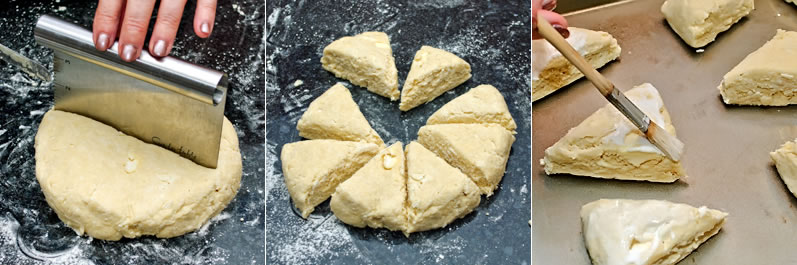
- The best shaping technique is one in which the dough is minimally handled and there are no scraps. I usually shape the dough into a disk at least 1-inch deep and cut the disk into wedges.
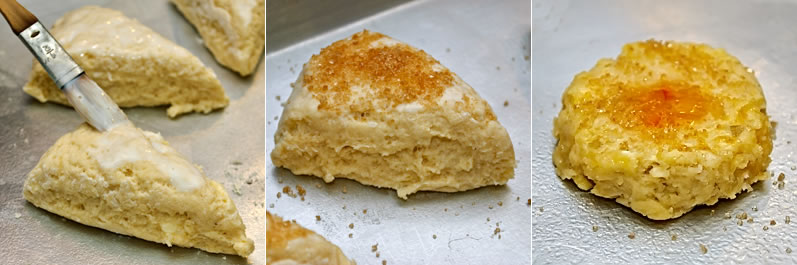
- With wet dough, you can also use a release-style ice cream scoop to shape balls of dough. Place the balls on an oiled cookie sheet and then flatten each one slightly with your hand. If you want to get really fancy, make an indent in the center of each little disk and fill it with your favorite jam before baking
- If you use a biscuit cutter, don’t twist it when you cut the dough. Twisting seals the edges of the dough and prevents the scone from rising as high as it might otherwise. Fluted and glass cutters have the same effect, so don’t use them. Here are my favorite biscuit cutters. They’re made of quality stainless steel and have handles that make them easy to use. But most importantly, they have the depth needed for a biscuit. Typical cookie cutters are too shallow.
- If you use cutters to cut shapes from the dough, gently push together the scraps to make the second cut.
Finishing
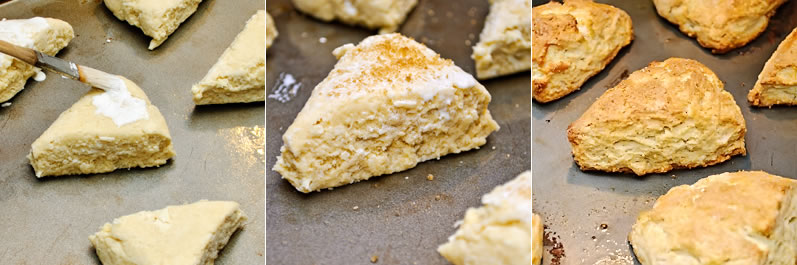
- If you use an egg, milk, cream, or buttermilk glaze on top of your unbaked, cut scones, don’t let it drip onto the sides of the dough. This may inhibit the rise.
- Demerara sugar is a nice finish for sweet scones, as it adds a crunchy top.
- You can either brush the finishing glaze over the entire disk and then cut it into edges or glaze individual wedges after cutting. A soft, natural bristle pasty brush is indispensable for this task.
Baking
- Don’t overbake scones. If you overbake, the scones will be dry and crumbly, rather than moist and tender. The bottoms should be golden brown and the tops set but only golden. The timing will vary depending on the temperature of the oven, the pan you use, and the size of the scones.
- Add ¼ cup of water to an ovenproof container and put on the lower rack of the oven 10 minutes before you bake the scones. The steam will assist with the rise.
- Bake scones in the upper third of the oven.
Eating
- Scones should be eaten right out of the oven. They are not nearly as good even only an hour after baking. The good news here is that you can make them ahead and keep them in the refrigerator for a day or even longer before baking, usually with no deleterious effect.
- If you do have leftover baked scones, simply warm them one or two at a time in the microwave for around 10 seconds. The texture will soften beautifully.
- The setting in which you eat the scone definitely affects the experience. Have your loveliest English bone china, hand crafted pottery, or Asian iron tea pot heated and at the ready, along with water brought just to the boil, a hauntingly fragrant loose leaf tea, and a beautiful tea plate on a tray, with unsalted butter and the most delicious jam you can find (preferably homemade) alongside. When you pull the scones from the oven, brew the tea, and then arrange the still hot scones on your plate. Retire with your tray to a secluded spot, such as the garden in summer or near the fireplace or a view window in the winter. Now savor fully over the next half hour.
Storing
- You can freeze scones after cutting and before baking. Completely defrost before baking and increase the baking time as necessary.
- Leftover baked scones can be frozen. When you want to serve them, thaw completely and reheat in a 350° oven for 4-6 minutes or in a microwave for around 10 seconds, just to warm through.

Ten Basic Scone Formulas
Note The following formulas are based on a constant of 2 cups of unbleached, all-purpose flour. Leavener, sugar, and salt quantities are variables. Formulas were extrapolated from cookbooks of respected culinary authorities (listed below).
Note Notice that the higher the proportion of butter, the less total liquid (eggs + liquid) is needed to hold the dough together, just as with pastry. The Balanced Formula in red text produces a fairly wet dough, which helps assure a tender, moist scone with good height. However, if the dough is too wet, it will spread, as well as rise, in the oven. So a balance needs to be achieved here.
No Butter, No Egg Formula (Yankee Kitchen Cooking School)
No unsalted butter
No egg
1 cup cream
Low Butter, No Egg Formula (Karen Demasco)
7 tablespoons unsalted butter
No egg
1 cup cream
Low Butter, High Egg Formula (Joanne Chang)
6 tablespoons unsalted butter
1 large egg + 1 egg yolk
½ cup buttermilk + ½ cup crème fraiche
Medium Butter, No Egg Formula (Flo Braker)
8 tablespoons unsalted butter
No egg
2/3 cup buttermilk
Medium Butter, Medium Egg Formula (My Balanced Formula)
8 tablespoons unsalted butter
1 large egg
¾ cup buttermilk, cream, or half of each
Medium Butter, High Egg Formula (Grand Central Bakery)
8 tablespoons unsalted butter
2 large eggs
½ cup buttermilk or cream
High Butter, Low Egg Formula (Flour Bakery, Joanne Chang)
10½ tablespoons unsalted butter
¾ large egg
1/3 cup cream +1/3 cup crème fraiche
High Butter, Medium Egg Formula (Once Upon a Tart Bakery, Frank Mentesana & Jerome Audureau)
10 tablespoons unsalted butter
1 large egg
½ cup cream or buttermilk
Super High Butter, No Egg Formula (La Brea Bakery, Nancy Silverton)
12 tablespoons unsalted butter
No egg
½-¾ cup cream or buttermilk
Super High Butter, Low Egg Formula (Once Upon a Tart Bakery, Frank Mentesana & Jerome Audureau)
12 tablespoons unsalted butter
2/3 large egg
6 tablespoons buttermilk

Jump to Recipe
More LunaCafe Scone & Biscuit Recipe
Inspiration from around the web
- Evil Shenanigans: Buttermilk Brown Butter Scones
- Food History: Scones
- Guardian: Dan Lepard’s Ginger Beer Scones
- La Belle Cuisine: Classic English Scones
- Lavender Blue: The Fluffiest, Lightest, Most Delicious Scones Ever
- My Bizzy Kitchen: Craisin Scones
- Our Best Bites: Basic Baked Scones
- Picky Cook: Raspberry White Chocolate Scones
- The Amateur Gourmet: Everybody Ought to Have a Scone
- Word of Mouth Blog: How to Make the Perfect Scone
Cookbook Faves
- Baking for all Occasions by Flo Braker
- Flour by Joanne Chang
- Grand Central Bakery by Piper Davis & Ellen Jackson
- Nancy Silverton’s Pastries from the La Brea Bakery by Nancy Silverton
- Once Upon a Tart by Frank Mentesana & Jerome Audureau
- The Craft of Baking by Karen Demasco

Please can you tell me amount of butter to use in scone recipe. It says 8 tbs can you tell me in ounces. Please.
Hi there Vicki! Eight tablespoons butter equals 1/2 cup, 1 stick, and/or 4 ounces. Hope this helps. 🙂
I’m still looking for the actual full recipe. (?)
I just saw the butter and egg variations but nothing on how much levening, salt, sugar, buttermilk. (??)
I enlarged the JUMP TO RECIPE link near the end of the post. Hopefully, it’s easier to see now. 🙂
Of the numerous scone recipes I’ve tried, these are simply the best and the easiest…hands down. I have made many sweet and savory variations and they never fail to please! I’ve tried rolling the butter out as posted in the directions as well as the traditional way of cutting the butter in and both ways have yielded excellent results. I never skip the folding phase! What works best for MY oven: Bake at 375 for 16 minutes and leave the scones in for 3 more minutes with the oven OFF. I always get a beautiful crunchy crust with a very moist scone inside! This IS the keeper scone recipe! Thanks Susan
Jojo, thank you so much! Will try your tips on baking temperature and time. 🙂
I love scones especially as we have to make our own since they’re not readily found here in Asia, and thus have tried many scone variation recipes.
Loved this recipe and it was very easy to follow. My scones came out perfect. Thank you!
Awesome to hear, thank you, Marianne! 🙂
Nice scones: The place in Perthshire “Scone”, is pronounced (Scoon as in spoon.) Scones in Scotland are pronounced Scone as in (gone.) I’m from Perth in Scotland. I ken! An aside: Afternoon tea is sandwiches, cakes and scones. High Tea is served in place of dinner: More of an early supper with something like pie and chips or egg, bacon and chips , ham and salad and chips, with scones, and cakes and tea.
Alastair, very interesting, thank you. I’ve never encountered the “scoon” pronunciation. So that makes at least three ways to say it. 🙂
Joann, thank you! The key to the scones rising is the chemical leavener. Check the date on the can to make sure it’s fresh. Also, for browning the crust, check the temperature of your oven. It might have been a bit low. 1/4 cup to 1/2 cup of water should not have interfered with the browning of the crust. I corrected the recipe to reflect 1/4 cup though.
Hello Susan,
I m excited about your recipe and am new to baking scones. Need to know how much sugar and baking soda is enough for the recipe. Will it be good without sugar since I can eat it with jam?
Hi there! Please scroll down in the post to the actual recipe. No sugar is required and the scones are very good even without sugar. Baking soda is only required if an acidic liquid is added to the dough, as specified in the recipe. Happy baking! 🙂
Thanks for the GREAT recipe! Made these yesterday morn – must have worked too fast as my very clod scones needed to bake for 22 min! They are incredibly tender and delish! I want to ask you about the nuances with doubling or tripling the recipe – often proportions don’t work out quite as simply as doubling or tripling them. Have you done this or do you have any recommendations for doing this? Thanks!!
Awesome news, thanks Robert! 🙂 You shouldn’t have any trouble doubling or even tripling this recipe. Happy baking! …Susan
Susan Bradley you’re a genius. Thank you for all the effort and hours you put into this. Your writing style is superlative. I wanted a scone like Panera. Ka-Ching! Hugs.
Carol Ann, you make my day. Thanks so much. 🙂
Tried your scones this morning using method 2 in my Kitchenaid mixer, and could not be more pleased! Fast and easy with perfect results, tender on the inside with crunch on the outside, lofty wedges with a gorgeous even golden brown color. Split beautiully to hold butter and fresh honey from our bees.
I took you at your word and did not work the dough at all, just plopped the mixture out of the bowl onto the granite. lightly floured my hands as the dough was a little tacky, formed into a rectangle, then envelope folded, flipped, formed into a circle, cut, and placed on a Silpat. Honestly, it was that easy! I did not handle the dough at all, and the entire process took less than 5 minutes.
In case anyone else has experienced it, I could see pieces of butter in the batter as mine were going in the oven, about the size of peas- but the results were perfect.
I have a convection oven so lowered the temp to 350 for 15 minutes.
Wonderful news, thank you Marcia! (Yes, you should be able to see paper-thin shards of butter in the dough.)
I don’t see a method 2 using food processor; is that somewhere? I did use a food processor to pulse the dough, feeling quite guilty about it, but they were nonetheless the best scones I’ve ever made! THanks.
Julie, so glad they turned out well! I purposely don’t use a processor because it produces small granules of butter rather than the larger pieces needed for sheeting the butter into the dough. (This said, if you are very careful to keep the butter pieces, large, it should still work.) When I compared the difference in pastries, biscuits, and scones mixed by hand or stand mixer to those mixed in the processor, I stopped using the processor for these doughs. There is a discernable difference. Hope this helps. …Susan
Thank you, Julie. 🙂 Method 2 is described above the actual recipe. Simply use the ingredient list and follow directions for Method 2. Hope this helps. 🙂
There are two methods for ensuring the butter is layered, rather than incorporated into the dough.
Method 1: Cut the butter into 1½ teaspoon size chunks (16 chunks per 1 stick butter). Dump the mixed dry ingredients out onto a clean surface and scatter the very cold butter on top. With your hands, lightly coat the butter chunks with flour by tossing the two together a few times. Then, using a heavy rolling pin, roll over the mass, flattening the butter into thin sheets. Gather the mixture up into a loose mass and repeat twice more. Scoop the mixture into a mixing bowl and continue with the recipe. After the dough is formed, flatten somewhat and gently make 2 letter folds (as for flakey pastry or croissant dough) in opposite directions. This will help to build flakey layers in the baked scone.
Method 2: Cut the butter into 1½ teaspoon size chunks (16 chunks per 1 stick butter). Add the dry ingredients to the workbowl of a stand mixer fitted with the paddle attachment. Scatter the very cold butter on top of the dry ingredients. Pulse the mixer to cut the butter into the flour, making sure not to cut the butter pieces too fine. Peas-size pieces are just about right. Add the wet ingredients and pulse the mixer a couple of times only to barely incorporate the liquid. Turn the dough out onto a clean countertop and finish by hand. After the dough is formed, flatten somewhat and gently make 2 letter folds (as for flakey pastry or croissant dough) in opposite directions. This will help to build flakey layers in the baked scone.
I’ve tried this recipe three times, each time chilling everything then rolling out the butter three times and chilling everything again, but every time the dough turns out sticky and unworkable. I had to add an extra cup of flour to make the dough something that i could handle.. What am I doing wrong?
Hi Kylie…
Flour is such a variable in bread baking because it contains different amounts of moisture depending on type and moisture level in the kitchen. It’s fine to add more flour as needed but the dough should be on the wet side. Mostly you just need to keep a little flour on the board and on your hands while you quickly shape the dough. What was your result when you added that extra cup of flour to the dough? Was the scone still light, tender, and flaky?
On America’s Test Kitchen TV show, they put dry ingredients and butter chunks into a plastic zip bag, pushed out all the air, and rolled with a rolling pin. Super easy, and no mess.
Rachel, great idea, thanks for sharing! 🙂
Rachel, good idea! 🙂
Hi
I am going to make berry scones and after reading your recipe I’m quite keen to make the dough the night before so I avoid the big rush around before my guests arrive. If I’m using frozen berries should I 1) freeze the completed dough (assuming they will defrost in the fridge and mess with the dough) or 2) refridgerate the dough and mix in the berries (gently) before shaping and baking?
Many thanks!
Hi there! With frozen berries, the best bet is to combine them with the dough just prior to baking. But then you will have to shape the dough the morning you plan to serve the scones. You could also add the berries to the dough and then quickly shape and freeze the scones–before the berries thaw. You have a lot of latitude with this dough. The tricky part is the frozen berries. You don’t want them to thaw before they go into the oven. Hope this helps. 🙂
You have certainly been a busy little Vegemite, haven’t you?!
In Australia we pronounce them as in ‘gone’ and anyone who uses the ‘scown’
is regarded as a bit la di da. I’m looking forward to the rolling pin technique.
Just a little niggle; the plural of ‘formula’ is ‘formulae’ not ‘formulas’!
I am so glad I’ve discovered your site and am sure I shall be visiting regularly.
Zizanie, thanks so much, love this comment. On the plural-of-formula front, the American Heritage Dictionary says either usage is fine– but even so, it wouldn’t be the first time I butchered the English language. 🙂
we say scone to rhyme with “gone” in Scotland, never to rhyme with “stone” and the cake has nothing to do with the place spelled Scone – that is pronounced to rhyme with moon! 🙂
You’re on top of the game. Thanks for sharing!
Thanks for the recipe!
I had some trouble when I tried this out, so I’m hoping you can give me some advice.
I chose “method 2” and used my stand mixer to make this. I used buttermilk, and 1/2 cup of frozen blueberries. I also added a 1/2 tsp of vanilla. As this was meant as a sweet scone, I added the sugar in the recipe, all 6 tablespoons. I was careful to keep the butter very cold, including chilling the mixer bowl and paddle.
The first difference I observed was that my dough seemed much wetter than the pictures you showed. It stick to my hands as I was forming it, and didn’t look at all like the relatively dry dough I see in your pictures. I don’t have a dough cutter (yet), so I used a slicing knife. It also stuck to the dough, and I had to cut multiple times to actual separate the wedges.
I refrigerated the formed dough overnight on the baking sheet, covered with plastic wrap.
I made sure the oven had fully preheated to 375, and added the water to the oven 10 minutes before putting the scones in. I brushed the scones with buttermilk, and added a little cinnamon and sugar to the top.
After baking, the scones didn’t really rise up as much as spread out. They turned out very “spongy”, and not the normal texture I would expect from scones. I thought they tasted ok, but my wife didn’t agree!
What could I have done incorrectly? Should I have added more flour, to compensate for the wetness of the dough?
On a side note, is the greased baking sheet necessary, or could a silicone baking mat be used instead of the grease?
Thanks for the recipe! I’ll try again one of these days, but hopefully you can give me some advice.
Hi Nate. It’s difficult to say exactly what went wrong without being in your kitchen with you. The dough is on the wet side. But yes, you could have added more flour. I suspect that perhaps the butter was over mixed into the flour. That is a potential outcome of Method #2. But I’m wondering if something else is going on here, as the scones should have tasted good, no matter what. Check the expiration date on your baking powder. That could be the culprit for the lack of rise. And yes, you can use a silicon mat if you prefer. Try again. Once you master the basic technique, you’ll have it for life.
You need to bake straight from mixing – your mistake was to leave the dough uncooked too long.
Can you confirm that your measurements are english or american cup sizes and spoon sizes, as I know they are different.
I am in America, but dropped here from England. Miss those scones, cant wait to try these.
Hi Nicole, and welcome to the United States. 🙂 I use American measurements. The flour is also specified by weight for accuracy. Happy baking!
Step 1 am I supposed to dump the dry ingredients onto a dry flat surface? before adding liquid? Totally confused
Fili, yes. I revisited the directions and they are clear. Please review the process with pictures above the recipe. You’re going to LOVE the results! 🙂
I made these last night using method 2, buttermilk, and no steam in the oven. They were delicious and my family loved them! Thank you!
I love scones! The first time I tried them was a while ago during a trip I had in Hawaii. I ate it at the hotel and now, I’m crazy for whatever scone recipe I can find. Thank you for posting such detailed and informative recipes! You’re a real craving-saver! 🙂
The best scones ever!!! Yum!!!!
Thanks so much for doing all this research and testing! Do you think a whole grain version is in the cards?
Stacey, you bet. You can substitute whole wheat flour for white flour, but the scones will be a bit heavier. A half and half blend would work well though.
I am so excited I found you post. I was looking to make a good breakfast snack to share with some of the guys I work with and I thought scones would be perfect. I’ve never made them before so I was so happy to find so many great tips! I’ll be making these this weekend!
I read all of the comments as well as your recipe for scones. I can’t wait to try them. I really want to make oat scones. Can you tell me how to adapt the recipe?
Thanking you in advance,
Patty
I had never made scones before, but followed your instructions and made scones that silenced a room. I had Irish people telling me they hadn’t had scones this good since Ireland. I fall asleep thinking about them. You must be some kind of evil genius!! 🙂 Thanks for the education.
I love scones. They are my favorite treat in winter time. I love to eat them with cream and jam. They are so yummy.
Oh YAY! I am learning to check your blog each time I want a fabulous, well-researched, well-though-out recipe for one of the “basics”. 🙂 I’ve been using Alton Brown’s scone recipe, which is very similar to yours. His calls for 4 tbs butter, 2 tbs shortening, which I had changed to 6 tbs. butter. After many failed attempts (involving freezing and grating the butter, and kneading the dough), I bought a GOOD pastry cutter, and stopped kneading the dough. My scone quality increased DRAMATICALLY. But, now I am excited to see your “roll the butter in” technique, with the 2 letter folds! Even though I just made 2 batches of scones tonight, I will be making another in the near future following your recipe and technique. 🙂 Thank you!
Amazing post! I have only made scones once, and have also been bewildered by the wide variety of recipes claiming to be the best, and yet they are all very different…!!! After reading your post, I am encouraged to make some scones very soon – love your description of crispy outside, flaky inside…and now I feel capable of achieving it!!! Delicious instructions and the scones look fabulous!
UrMomCooks, there certainly is a lot of latitude in the proportions of the key ingredients; now that you have the potential range, you should be able to arrive at your perfect scone. I tested the all cream formula yesterday (with cocoa added) and it still amazes me that it works. The scones were light, tender, and moist, although not flakey. It’s not my favorite scone but certainly respectable and perfect when ease and speed are of utmost importance.
You sure put a lot of work into this post. Thanks for sharing these amazing looking scones. Yummy!
Nancy, thanks! 🙂
Blake, I assure you that I surveyed the ENTIRE universe. 🙂 Perhaps your clients would like Candied Ginger Lemon Scones? Just add 1/2 cup chopped candied ginger, and finely grated zest of a large lemon to the dough AFTER you layer in the butter and before you add the liquid. They really are hevenly!
Wonderful–and just a day before Robert Burns’ birthday, too! Thank you! (I’m a Scot, born and bred and now living in the USA.) One point: English folks say “scone” as in “stone” but we who invented this delicacy (the Scots), say “scone” as in “gone.” Any who love this delightful basic of a genteel afternoon tea should take note and do the same. 😉 (Taking back the Colonies, one tea drinker and scone eater at a time…)
Eam, I hit Robert Burn’s birthday? Seriously? How cool is that? 🙂 Thank you for the distinction between the pronunciations. Scon it is then. Also, I promote the afternoon tea ritual every chance I get. I consider it essential to sanity. 🙂
Whoa, whoa, get out the way with that good information.
One post and I feel like I’ve found the definitive source of scone-making insights. I love the pastries here in Naples but they are very, very in love with their culinary traditions here. Years of loving American soldiers have allowed muffins and doughnuts to break through, but no scones!
I’m bookmarking this for future experimenting.
Joshua
Joshua, thank you! You can be the ONE to bring the scone (pronounced gone as Eam suggests above) to ITALY! You can do it. We have faith in you. 🙂
You are my hero! This is the BEST treatise on scone making In The Entire Universe! I have read every scone technique and every recipe on every website I could Google, looked at every Youtube demo, and none of them explained it as concisely and pefectly as you have here. I’m new to appreciating the world of scones, Pft’ing them off as a bisquit with egg and sugar, until recently. This new obsession has sorely tested what I thought was my decent skill with dough (though I can make a decent bisquit..go figure!) I have produced leaden, dry and woefully thin wedges of barely edible particleboard that disintegrate on contact with knife or teeth. Now, with your help here, I think I get it! Thanks, Susan…I’ll love you forever for this! (I’ll let you know how I fare.)
Oh, Susan my hero! I made a batch of these this afternoon and they were perfect. PERFECT! First, I had a little bit of a problem rolling the pin over the flour/butter mixture, but I fixed it before the second roll. I used one of my flexible cutting boards on top of the mixture and rolled the pin over that. At least I could scrap the buttery dough bits off with my bench scraper! I also took a clue from your picture of the dough before you cut the wedges. I patted it to a round that was an inch thick before cutting it. The baked outcome were lofty wedges of pure delight; just crisp on the outside and tender and flakey inside with just the right amount of sweetness. I added a loose teaspoon of finely grated lemon zest to the flour and tossed some candied ginger, finely diced with some of the flour, after the butter had been incorporated. They were heavenly. Outstanding instructions and perfectly balanced ingredients. Thank you so, so much! I feel accomplished!
Susan, I am elated, thank you! 🙂 What a good idea to put something over the butter. Wax paper might also work. I made Candied Ginger & Lemon Scones too! I’ll share the recipe later but sounds like you have it down anyway. Also made Bacon and Cheddar Scones and Blueberry Lemon Cornmeal Scones. The possibilities are endless.
Susan, what a thrill to hear! 🙂 When I started the research, I couldn’t find complete directions anywhere either. Lots of recipes but only bits and pieces of technique. It’s so important to understand the foundations of a dish. Happy baking!
I have a serious thing for scones, so this info is so great to see. Thanks for posting this! Can’t wait to try your version. They look like perfection.
Lisa, thank you. 🙂 Let me know how they turn out.
That is an amazing wealth of info > Thank-you..mine always taste and feel like bricks!
Astheroshe, your scones will never be bricks again, I assure you. 🙂
wow! you should have a PhD in scones with all the research that went into this post. If you still love scones after baking so many of them that’s a sign that you truly made the best scones in the universe.
Sarah, now that my scones are perfected, I can’t seem to get enough of them. Good thing the freezer is full of several varieties. 🙂
And more than likely the best butter curls in the entire universe. 🙂
Matthew
Matthew, are you making fun of my butter curls? 🙂