
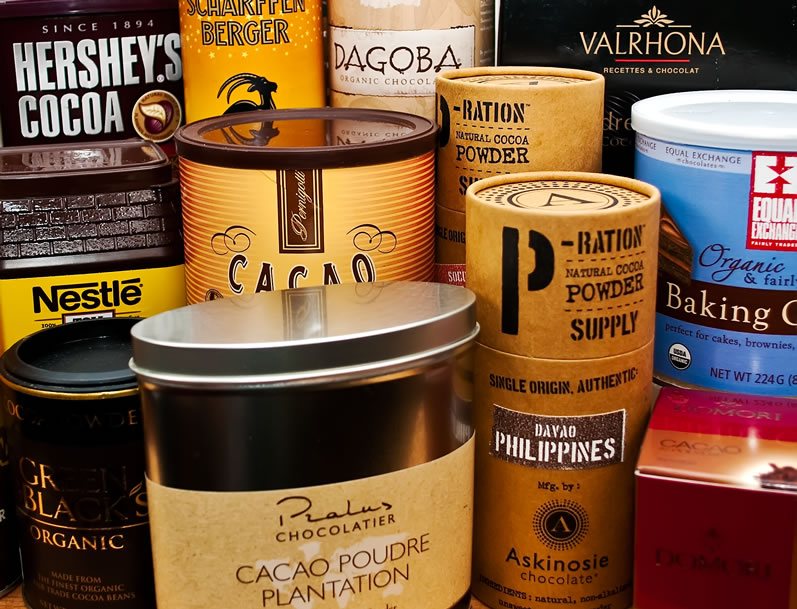
NOTE This is an update of the original post, with the addition of several more cacao powders to the tasting notes.
With the proliferation of cocoa powders available today, how is a cook to know which is the “best” to use for any particular purpose?
Types of Cocoa Powder
To complicate the selection process, there are three types of cocoa powder: natural, alkalized (Dutch process) and super alkalized (black or onyx). Often, it doesn’t matter which one you use, but if you are baking with chemical leaveners, it does.
If your recipe calls for baking soda (alkaline) as the leavener, you need to counterbalance with a natural cocoa powder (acidic), unless the recipe calls for sufficient other acidic ingredients to activate the baking soda. An alkalized cocoa powder, which is neutral, will not activate the baking soda.
If your recipe calls for baking powder (balanced alkali and acid) as the leavener and contains no additional acidic element, you do not want the cocoa powder to shift the balance, thus you need an alkalized (neutral) cocoa powder. If an acidic element is also present, however, you might want to balance it with an alkalized cocoa powder.
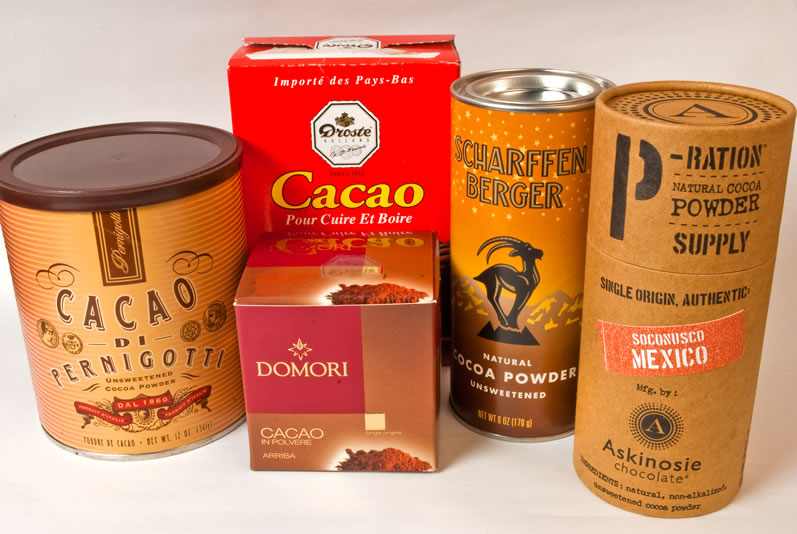
To make sure we keep these straight, keep in mind that:
- Natural process cocoa has no added alkali. It has an intense bittersweet flavor with high natural acidity and full fruity flavor.
- Alkalized cocoa (also called Dutch process cocoa) is treated with an alkali, which helps neutralize cocoa’s natural bitterness and acidity. The alkalization process produces a powder that is typically darker and redder than naturally processed cocoa. Don’t assume, however that darker color implies deeper flavor. Alkalized cocoa is typically milder in flavor than naturally processed cocoa.
- Super-alkalized cocoa (also called black or black onyx cocoa) is alkalized to the extreme, producing an almost black cocoa powder. It contains less fat than other cocoa powders, and this lack must be compensated for in any recipe in which it is used.
To ascertain what the “best” cocoa powder is for you or for a specific culinary creation, purchase several cocoa powders (some natural, some alkalized) and conduct a taste comparison.
And remember that “best” is a relative term. Everyone’s taste buds are different, and you may appreciate a cocoa powder that I don’t, or vice versa. In addition, sampling a cocoa powder straight on with only a little sugar and water may give a different perception than the same cocoa powder baked into a brownie or blended into a pudding. So you may want to put a few of your favorite cocoas through a couple of basic baking tests as well.
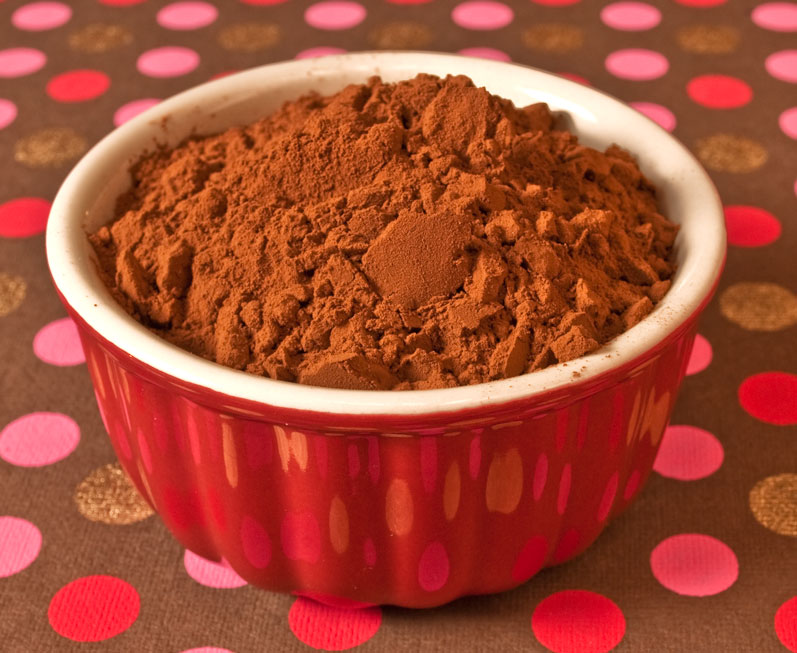
To Sample a Range of Cocoa Powders
- Set a small, narrow, clear glass in front of each cocoa container. A shot glass is perfect for this exercise.
- To each glass, add 2 teaspoons cocoa powder, 1 teaspoon superfine sugar, and 1 tablespoon hot tap water.
- Stir to dissolve the cocoa and sugar. Set a clean spoon in front of each glass.
- Now, start on one end of your row of samples and taste your way through the cocoas, making sure not to mix the spoons.
- Take brief notes as you taste. Note color, aroma, texture, flavor notes, balance, and finish. Try not to jump to an immediate conclusion. Taste again very slowly and deliberately.

I have been buying wondercocoa for many years. It is 98% caffeine free. The price is very high ex- 17.99 for 6 Oz can from amazon. Is there a comparable cocoa that is 98% caffeine free or close.
Lisa, yes, quality cocoa powders are increasingly expensive. I’ve never noticed caffeine amounts specified on cocoa packages, so not sure how to ascertain this. Check out this article: http://www.food-info.net/uk/qa/qa-fp47.htm.
Wondercocoa is around $8.00 at Whole Foods and they’ll give you a 10% discount if you buy a case of it, which we do….Our other favorites are Rodelle (from Holland, I believe) and the Pernigotti is out of this world but watch the ingredients: you want cocoa and vanilla NOT cocoa and vanillin (a cheap artificial vanilla). Next on the list is Valhrona and Callebaut.
Keep in mind there is very little caffeine in any cocoa powder or chocolate (compared to a cup of coffee or tea, for example). If you are bothered by the energy rush–as I was–it’s probably due to the dose of theobromine in it. A friend of mine with severe hypoglycemia investigated this thoroughly:
http://en.wikipedia.org/wiki/Theobromine#Pharmacology
Theobromine is used medically as a heart/neuro stimulant:
https://en.wikipedia.org/wiki/Theobromine
I have solved many of my health problems and can now drink regular cocoa powder but stick to a low-carb, sugar-free diet and feel great. Chocolate is a real treat for me.
Have you ever tried Bergenfield’s line of cocoa powders? OR have you heard anything about them or their quality?(They sell cheap Samples.)
It appears to come straight from Ecuador and I would love to know how you’d compare/describe it…
BTW, This is Still the Best article I’ve found on cocoa powder nuances and flavors! Well Done!
Peter, i haven’t heard of Bergenfield’s cocos powder. Will see if I can find it. Thanks for the suggestion. 🙂
Excellent post Susan! I would love to narrow down which brands are allergen friendly but at least now I’ll know which ones are tasty and worth looking into some more. Thanks!!
This blog is older, so probably moribund, but I was researching cocoa for health purposes and came across it. Thought I’d share some nutrition information.
The flavor of a chocolate seems to be inversely related to its health benefits. The raw theobroma seed is bitter because of the (epi)catechins and flave3ols it contains. They are there to protect the seed against all the nasty things that want to eat it in the tropical environment. They are also the source of all the wonderful health benefits that theobroma provides. Processing the seed is what yields the rich flavor of chocolate. Most important is the fermenting of the seeds, since it destroys the most (epi) catechins, and thus bitterness. Roasting destroys more of them, though less than fermenting. And Dutching or alkalizing, completely eliminates them. But, oh, it does wonderful things for the flavor.
So, there is a trade off between health and flavor. Of all the chocolates you tested, the one whose taste description by you comes closest to raw cocoa powder is the standard Hershey. It probably provides the most health benefits, by sacrificing chocolate flavor. Guess it depends what you want the cocoa powder for. Maybe a raw(er) one for health (a teaspoon a day) and a more processed one for flavor is the way to go.
Stan, thanks for your thoughts. Alkalized chocolate is interesting. To my palate, natural process chocolate has the richer, brighter flavor.
Thanks to The Chocolate Garage in Palo Alto, CA, I could have told you that these top picks would have emerged! Love love love craft chocolate.
Hi! Which cocoa powder do you think can be a substitute for Valrhona Cocoa Powder? Do you think Callebaut Cocoa is a good one?
Jen, I have always liked Callebaut chocolate but have not actually tried the cocoa powder. I’m not sure where it is available except by special order. Any of the 2 or 3 star chocolates that I list taste especially good to me.
I recently purchased a 2.2lb bag of Valrhona for baking. Using your method of taste testing I noticed a very peculiar taste so dominant that it took away the joy of the chocolate flavor. I went ahead and baked
a batch of bouchons, thinking that the odd taste would be eliminated. It wasn’t and when I served them
everyone commented on the odd flavor. Can you add any light on this? I don’t know if I have an inferior
unit of product or if this is how this product tastes.
Lee, that is very odd. Valrhona usually tastes like heaven. Is this the first time you’ve tasted it? It sounds like something went wrong in the manufacturing or packaging process. Please alert the manufacturer.
I have tasted Valrhona cocoa used in baked products before and never noticed an odd smell
or flavor, however, I never have used it personally. I am taking it back to the restaurant supply
tomorrow. I will email the manufacturer. Thanks for your help.
Lee, I’m very curious to hear what they have to say. I’ve never experienced anything odd with Valrhona cocoa powder. For the price, it better be PERFECT. 🙂
Awesome blog! Is your theme custom made or did you download it
from somewhere? A theme like yours with a few simple adjustements would really
make my blog jump out. Please let me know where you got your
theme. Appreciate it
Cowgirl,thanks! LunaCafe was designed by SoapPig (AKA MauiJim). You can reach him at jhb@thelunacafe.com.
I really loved this post! I live in Canada and was wondering how I could go about procuring any of the cocoa powders mentioned above?
Pralus Cacao is my favorite too! What a splendid exercise you prepared. I wonder if Claudio Corralo in Seattle sells cocoa powder? I’m obsessed with his 100% cocoa mass,I snack on it when I can get my hands on it. Also I think TCHO sells cocoa powder, they make a ht Ochoa shot which is essentially the same recipe you employ for tasting.
Again, awesome weblog!
Thank you for this comprehensive comparisons! I just tasted Scharffen Berger cocoa for the first time, and it’s spoiled me. I could have it unsweetened. Might make the leap to Askinosie, but it is pricey. So many choices!
My recipe has both baking powder and baking soda, so which type of cocoa should I use?
I meant to say to avoid chocolate where point of origin of the cocoa is the Ivory Coast. Obviously you can’t tell anything by the country where the final product has been produced.
Quite the tasting service you’ve provided! I recently bought some cocoa, I wanted something fair trade and organic, since that would also insure that it would be slavery-free (organic certification includes a labor quality standard). Another way to avoid slave labor is to avoid chocolate produced in the Ivory Coast. I chose between the three kinds at PCC co-op. Guess I’m glad I didn’t pick Equal Exchange since you really didn’t like it. I chose Rapunzel which isn’t on your list, and while it worked in my recipe, I’m not convinced it’s the best I can get. Dagoba is fair trade, you didn’t seem to like it either. Fortunately, so is Green & Black which you liked a lot better. I will try that next time.
It would have been interesting to see the results of a blind taste test and know the origin of the cocoa beans for each brand but thanks for the information. I’m always in pursuit of the best products to use in my baking and you’ve given me some new ones to evaluate.
A sophisticated palate and complementary evaluations! Thanks for the feedback.
I had ignored cocoa powders until this year (except for an occasional cold day hot cocoa drink). I did not know that such variety exists. Might we hope for a business to offer an introductory box containing many samples?
Thank you, Rob, and you have a great idea there. It was VERY costly to purchase all those cocoa powders, but I get a little thrill now whenever I open the cupboard dedicated to their storage. 🙂 At my former cooking school, Northwest Culinary Academy, we did extensive chocolate tastings, which were always interesting. It was only later though that I realized cocoa powders were just as diverse in flavor.
The Tessera de Cocoa recipe (online, using Black Cherry Concentrate) was created with Ghirardelli Natural Unsweetened Cocoa for its characteristics (as described in this comparison list), but also for its general availability, price and assumed level of antioxidants. Do the higher rated natural process cocoa powders in this list also rate higher in antioxidant level?
Rod, I am guessing that antioxidant levels are similar in these quality cocoa powders. Please note that the rating here is entirely subjective, based on only my palate. My intention with the comparison is to get folks to conduct comparisons themselves. Also, while I may prefer some of the pricier cocoas, I do consider cost when choosing which cocoa to use in any given recipe.
I tried adding chocolate nibs to the Tessera recipe to increase the antioxidant level and create chewiness. After the cocoa powder was mixed with virign coconut oil, I soaked the nibs in hot water, drained them and added them to the heated chocolate mixture in the pan. Lesson learned: oil and water don’t mix (the remaining water in the nibs separated, creating a gooey mess). Next time, I’ll just grind the nibs a bit in a coffee grinder and add them directly to the warm chocolate mixture.
Rod, oh yes, I have many a hard lesson with chocolate myself. But why do you want to grind the nibs? They have a lovely crunch. I’m afraid if you grind them that they will lend only grittiness. Let me know what happens.
Susan,
The granular size of the nibs is not complementary to the Tessera recipe concept. I had to purchase another bag of nibs for today’s testing and discovered that some brands are better than others (tastier, less gritty fiber).
But I first tried simmering the nibs in vigin coconut oil: crispier nibs (I should have known), but an interesting option for snacking, dessert toppings and some recipes!
Then, I ground the nibs in the coffee grinder: as you expected, the grittiness was still present. However, a new food item was created: natural chocolate flavoring for brewed coffee! I’ll keep a supply next to my ground coffee (or mix the two ahead of time).
Analysis: no nibs for this recipe (but nibbling on the side is nice).
Clarification: the simmered nibs were not used in the coffee grinder. Also, I was reminded to not lick spoons used to stir hot oil – nibs or not!
Comment: Cocoa powder clogs coffee filters – the ground nibs should have the same texture as regular ground coffee. Using 1 tbsp ground nibs to 2 tbsp ground coffee, the chocolate flavor is subtle, but pleasing.
Comment (again): the ground nibs and coffee are very good! (even as reheated coffee). Unlike adding flavoring or chocolate powder (or syrup) to brewed coffee, the nibs add flavor depth similar to ground coffee beans.
Rod, that’s great to know, thanks for sharing!
I’ve already settled into a coffee brewing routine using the “cacao brewing nibs” (1 tbsp brewing nibs per 2 tbsp ground coffee). The nibs seem to mellow the coffee slightly (perhaps like chicory) as well as give it a light chocolate note. My inexpensive coffee grinder creates some cocoa powder, so I use a strainer to isolate the brewing nibs. This coffee flavor is such pleasing accompaniment to chocolate desserts that I’ll need to wear a seat belt when the dessert cart rolls by!
I should have said “creates some cacao powder” since cocoa powder involves more processing than just grinding nibs.
Adding the moistened nibs to the heated Tessera mixture in a pan on the stove was the mistake. This procedure is best (for the recipe quantity):
1. Soak 1/3 cup nibs, covered in very hot coffee, for 30 min. (cover the container wihle the nibs are soaking). Then drain well with a strainer and allow the strainer to set on paper towels while the Tessera mixture is prepared.
2. Before pouring the Tessera mixture into the bowl, spread the moistened nibs evenly in the bowl. Then, slowly pour the mixture over the nibs.
3. Refrigerate, then slice as per the recipe.
Nibs soaked in coffee (or hot water), then drained well, may also be stored in a covered container in the refrigerator for later use. The nibs remain very chewy, but not so crunchy.
A final comment about adding goodies: spread dried black currants and/or raw sunflower seeds on the wax paper (instead of the nibs) for healthy “energy squares”.
Thanks for sharing, Rod! 🙂
My previous comment posted before editing was completed. It should have read:
More experience: Cacao nibs that are not moistened grind best when cool (more oil might be separated from nibs that are warm).
Also, 3/4 cup of black currants (or dark zante currants) perfectly complement the quantity of chocolate mixture in the Tessera recipe when creating “energy squares”. Don’t like currants? Try diced, dried cherries or dried wild blueberries!
i’ll f/u – thanks so much !
great post — have not been able to find out where to purchase Pralus Cacao Poudre Plantation in the US. Can you please direct me? thanks
Maria, thanks! I bought Pralus cocoa powder at Cacao Drink Chocolate in Portland, Oregon. Great shop if you are in the area. Otherwise, check out their website at http://cacaodrinkchocolate.com/.
Hey very cool site!! Guy .. Beautiful .. Superb .. I will bookmark your blog and take the feeds additionally?I am glad to search out so many useful info here within the publish, we’d like develop extra strategies in this regard, thank you for sharing. . . . . .
http://www.facebook.com/note.php?note_id=173712330669
What about the new Trader Joe’s unsweetened cocoa powder from Columbia made from Tumaco cocoa beans?
Thanks for all this information – really helps clarify for me, and I’ll know where to start, with so many options!
Laura, there are more wonderful cocoa powders available every month it seems. I am having a difficult time keeping up with all of them myself. 🙂
Hi! This post was awesome, I had only recently found that there are so many better options for cocoa powders that are not Hershey’s. I have a question though, if the recipe doesn’t specify whether or not to use natural or Dutch, and the baking soda & baking powder are of equal quantity, what would be better to use?
Thank you, Ida. In my recipes, I try to always specify which cocoa powder I used to get the results described and shown. However, in the case you mention, if the cocoa powder type is not specified, I would assume the author intended natural process cocoa powder. Either would likely work though. Hope this helps.
what would you recommend as the best chocolate powder to be used for a rich dark chocolate flavor with non fat yogurt, I make a great chocolate like mouse sweetening it with stevia…been using Hersheys dark chocolate powder and wondering about trader Joes if it would be dark flavor enough…I would like a darker chocolate flavor than that Hersheys as well…thanks ….Linda
Linda, all unsweetened cocoa powders on the list have a deep chocolate flavor. However, overall flavor varies considerably. To my palate, Hershey’s cocoa powder has a distinctive, unpleasant flavor that is both metallic and musty. Per my tasting notes on Trader Joe’s organic cocoa, the acidity level may not be what you want with yogurt. Perhaps try Valrhona cocoa power instead.
I’m going to make a chocolate beet cake that has 2 teaspoons of baking soda but also has the beets. Makes me wonder whether I should be using natural cocoa as you suggest or alkalized. Important as we’ve got a dessert competition going on Christmas Eve! Thanks for your post.
Gail, of course there are always recipes that feature exceptions to the rule, but in general, baking soda (an alkaline) interacts with acid (natural cocoa powder) to create the leavening action. You’re correct to suggest that the beets also provide acidity. However, with this extreme quantity of baking soda (1/4 teaspoon baking soda = 1 teaspoon baking powder), my inclination would be to use a nautural (non-alkalized) cocoa powder. Check out the Heavenly Chocolate Beet Tea Loaf I created earlier this year: https://oceanic-mystery.flywheelsites.com/heavenly-chocolate-beet-tea-loaf/. It uses a small amount of baking soda to offset the natural cocoa and then baking powder as well. So you have options here. Hope this helps. Happy baking! …Susan
Here is a question you may or may not be able to assist with… this post is delightfully helpful in finding the best cocoa powder, but I have a recipe that presents a bit of a problem… it is a cake, and it uses both baking soda AND baking powder.
Now this is my scientist side coming out… there is a considerably larger amount of baking soda than baking powder (2 teaspoons of soda to 1/2 teaspoon of powder). My logic would dictate, then, that I should probably use a natural cocoa powder, since there is more of the alkaline soda than of the neutral powder… do you think this would be a safe assumption?
Sarah, your conclusion is correct. You need acid (natural chocolate) to react with the baking soda (alkaline). However, that’s a ton of baking soda; the equivilent of 8 teaspoons of baking powder. It will be interesting to see how that turns out. Do let us know.
My Trader Joe’s has an alkalized cocoa powder. I haven’t tried it, but none of the other grocery stores carry descent alkalized cocoa powders, so I was thinking of trying it. Can anyone recommend it?
Can you post the stores where you buy your preferred cocoas?
Karen, the stores are listed under each cocoa in the Purveyor line. I also linked each cocoa to the producers web site, in case you want to purchase the cocoa online. I bought all of these cocoas in Portland Oregon at either City Market, Pastaworks, Sur La Table, Williams Sonoma or Cacao. Hope this helps. Best…Susan
Wow! This is an excellent post that I’m sure is going to be a resource that I’ll rely on for all of my future cocoa needs. To be honest, I couldn’t afford to sample this many cocoas. I’m getting into truffle-making, so it really is a treasure. Thanks, Susan.
Thank you, Dani! So pleased this post is helpful to you. I got a little carried away buying all those cocoas. 🙂 On the other hand, what a delight to have them on hand.
looking for a dark chocolate unsweetened powder to use for drinking with milk…can the dark chocolate powders you listed here be used for this simple purpose or are they meant exclusively for baking?
Oh yes, Dee Dee, premium quality cocoa powder makes superb drinking chocolate. The basic proportions are 2 tablespoons unsweetened cocoa powder, 2 tablespoons sugar, and 1 cup milk. You can tweek to your taste. You might also be interested in a richer style drinking chocolate that I talk about in the the post titled A Gift of Drinking Chocolate at https://oceanic-mystery.flywheelsites.com/a-gift-of-drinking-chocolate/. Best…Susan
great idea for a post. this makes me want to go try a lot of different cocoas!
Amazing post–and I am totally impressed by your tasting expertise! (I tried to do the same with wine once. . . sadly, I just got tipsy). Also worth mentioning that the natural process (unalkalized) is higher in flavonoids that act as antioxidants in the body–more natural, and much healthier, too!
.-= Ricki´s last blog ..Apple Pumpkin Crumble Bars (ACD Friendly) =-.
Ahhh Ricki, thanks for mentioning that aspect of the natural versus alkalized cocoa conundrum. I recently read that the original reason for the alkalization process was to make bad (rough, bitter, overly acidic) cocoa beans palatable. Okay, that makes sense. However, now the quality of beans that the best producers use is so high that alkalization is not necessary. Best…Susan
What an excellent post. I’m in awe at all the many varieties of cocoa powder you have there and your knowledge about them. I’ll be sure to increase my supply of cocoa powder soon based on your advice. Thank you.
OMG! i love cacao! 🙂 but no also so many types of turkey 🙁